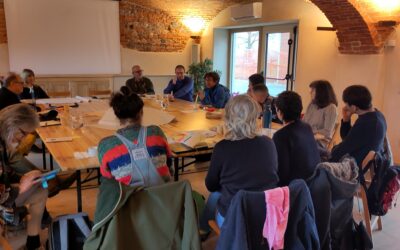
What are the keywords of agricultural diversity? Within the DIVERSIFOOD project, this was a crucial question in order to define a common ground of concepts and methodologies. After an intense working group activity, the consortium came up with a set of 8 key concepts
All these keywords were gathered under a main umbrella concept: “resilience”.
“The overall challenge – explained Edwin Nuijten of LBI and leader of this DIVERSIFOOD work package – is now maintaining diversity in methods, methodologies and paradigms. We need to combine the different keywords and concepts, not to homogenize them”. A Diversifood booklet defining these keywords will be published in the coming months.
DIVERSIFOOD uses a combination of approaches to optimise the management of on-farm, multi-actor crop evaluation.
Within this framework, a major objective is to build an inventory of underutilised crops for marginal/specific conditions and new utilisations. This goal was reached during the first part of the project, starting from this question: “what is needed to be known about a new/underutilised crop, and which needs should a trial answer?”
“The main problem – explained Ambrogio Costanzo of ORC and leader of this DIVERSIFOOD work package – is that quantitative information is not available for the species we’re working with: that’s what we aim to obtain in the project”.
At the same time, some preliminary crop trials were set up. The crop evaluation process is being carried on using participatory approaches, in order to build up new knowledge and bring up knowledge that is already on the field.
“Developing new populations and improving them with different breeding methods”. This is one of the main goals of DIVERSIFOOD, as explained Isabelle Goldringer of INRA and leader of the work package about participatory crop improvement.
As important as the discovery and characterization of diverse and untapped genetic resources, their combination and use through the development of new populations and their improvement is of vital importance.
In order to reach this goal, DIVERSIFOOD is developing new breeding methods for creating diversity from genetic resources towards new populations.
During the first part of the project, different experimental designs were settled: among them, RAS, ITAB, and RSP are testing tomatoes varieties in farmers’ fields; INRA, RSR, RAS, RSP are working on several forms of untapped or forgotten species or forms of cereals; INRA and RSP are working on buckwheat; CSIC is working on faba bean; ITQB in collaboration with IPC is working on maize for human food; FiBL is dealing with lupin resistance against Colletotrichum.
The results of the different experiments will be used to design methods and user-friendly tools specifically suited for on farm breeding. The new derived populations, as well as the developed methods, will serve to improve production global performance while maintaining diverse and rare qualities corresponding to emerging consumer demand.
INNOVATIVE BIODIVERSITY MANAGEMENT
What is a Community Seed Bank? What are the most effective case studies to be analysed in order to promote locally produced seeds? What are the key actions to support an innovative biodiversity management?
During the first year of the project, all these questions have been addressed. A preliminary list of all the experiences working with local varieties and referring as potential Community Seed Banks (CSBs) were identified. The first innovation factsheet on Defining Community Seed Banks was produced.
The crops to be used as case studies dealing with locally produced seeds systems were also defined: tomato, wheat, buckwheat, maize, carrot and potato.
Moreover, an agreement was signed with the CAPSELLA project. “In synergy with DIVERSIFOOD – explained Riccardo Bocci of RSR and leader of this work package – CAPSELLA will improve the database of seed conserved and distributed in/from European seed houses. The final goal is building a useful tool which will gather information about soil and climate”.
EMBEDDING DIVERSITY IN THE FOOD SUPPLY CHAIN
It is crucial to the DIVERSIFOOD project, that food diversity based on heritage or newly bred varieties from participatory plant breeding can be introduced into the market. The overall aim is to produce recommendations and guidelines for their marketing and valorisation strategies .
To that end, different case studies will enable to identify critical factors of successful or unsuccessful marketing strategies and to analyse in detail the whole process of added value and communication from the breeder to the consumer.
“We’re exploring consumers’ preferences – said Bernadette Oehen of FiBL and leader of this DIVERSIFOOD work package – in order to find the best ways to communicate the added values of diversified food”.
The consortium defined all the stakeholders to be included within this process: successful market introduction requires some collaboration and communication between all the actors involved from breeders/multipliers, farmers, technicians, processors, retailers, intermediate users and the final consumers.