

RISO RESILIENTE; Beyond the yield driven strategy: breeding for specific adaptation in organic rice in Italy
Italy is the largest producer of rice in Europe. The production is mainly located in the intensive agricultural areas of the Po Valley, which are also among the most fertile areas of Italy. In these areas, agriculture is based mainly on monocultures and intensive exploitation of land, together with a widespread use of chemical inputs and water. However, during the last decades organic rice production has increased, often lead out by the self-organization and cooperation among a number of pioneers’ farmers. The implementation of a new rice breeding strategy, specifically targeted to the organic rice farming systems (ORFS), represents a necessary and urgent contribution to this transition.


Riso Resiliente have fostered a set of farmer-led innovations, ranging from agronomic practices for ORFS management to participatory breeding (PPB). The activities involved a multi-actor network in participatory selection of locally adapted varieties suitable to the agro-ecological practices of each farm hosting the field trials. The main objective of this research is to address the most urgent critical issues in ORFS such as water scarcity, soil salinization, climate-driven presence of novel aggressive weeds, the coexistence with many animals in wet habitat and the emission of greenhouse gases (GHG).
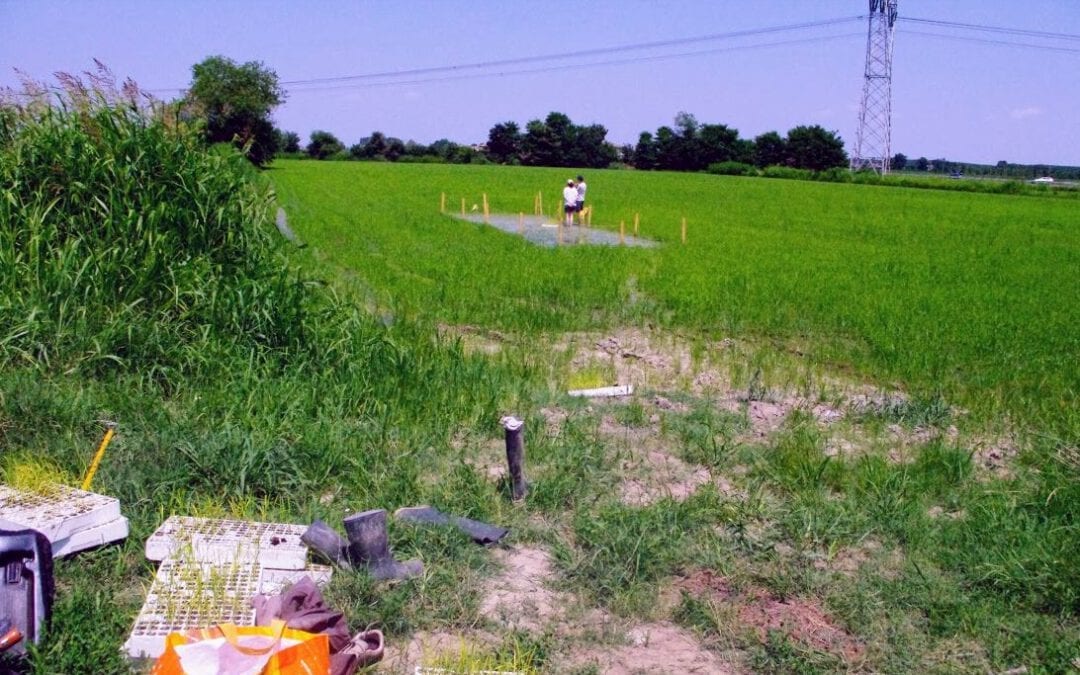
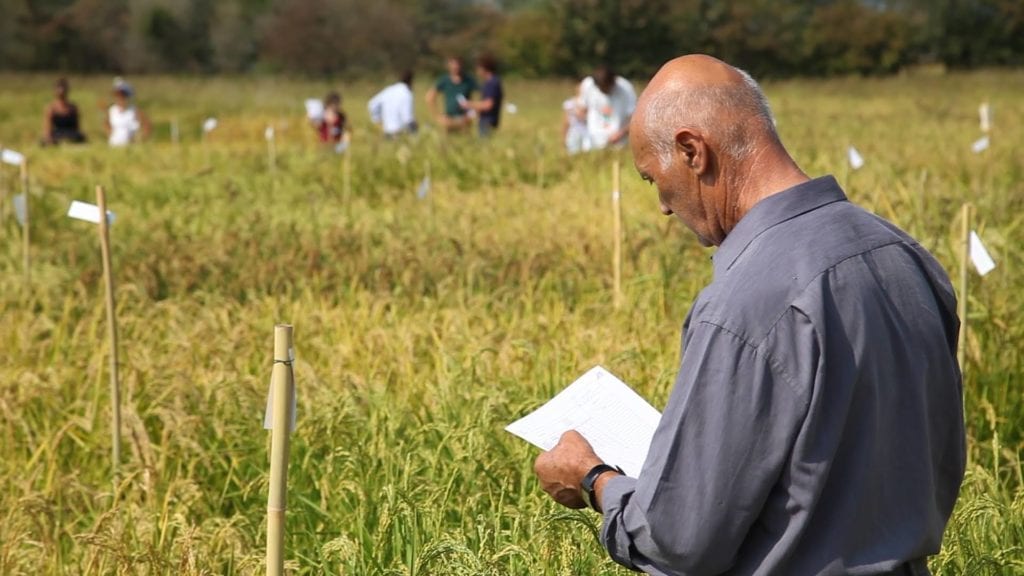
In 2019 four organic and biodynamic rice farms hosted on-farm trials for the evaluation of 17 local rice varieties (released before 1960) with the aim of identifying those most suitable for ORFS. The experiment was set up as an incomplete randomized trial divided among four farms, each adopting different ORFS management practices. The fields were prepared following the prevalent weed control management practices in the region: i) rice dry sowing at different depths (6 cm or 3 cm), followed by dry conditions combined with different intensity of mechanical weeding (two or four comb harrow passages); ii) sowing over green mulch obtained from different cover crops, followed by flooding. The trial was repeated in 2019 and 2020, using a partially replicated design with plots size of 6 m2, 16 unreplicated varieties and 6 varieties replicated 4 times. The resulting 40 plots were arranged in 4 rows and 10 columns. A number of phenotypic traits were collected ranging from ear height to plant height, stem posture, tillering and susceptibility to Fusarium spp and Pyricularia oryzae. The participatory evaluation involved more than 120 farmers, technicians and researchers who scored each plot from 1 (worst) to 5 (best). The data were submitted to spatial analysis, ANOVA and PCA (GGE Biplot) with GenStat v 20 and R software.

Preliminary results indicate that for most phenotypic traits there are significant differences not only between accessions but also within the same accessions among the farms hosting the trials. The interaction between “farms x varieties x field management” was significant for “height” and “ear length”, as well as “disease tolerance” and “weed suppression”, two traits that are relevant for ORFS management.

The results allowed the identification of some promising agronomic/varietal combinations that can increase yields and yield stability over time. This emphasises the importance of specific adaptation for rice cultivars, although farmers’ knowledge of their agro-ecosystems remain pivotal for successful ORFS management. The application of a decentralized and participatory selection model within a community of practices that have long been deploying organic rice management techniques is the prerequisite to define a new breeding strategy tailored to site-specific needs. Our research shows that the heterogeneity of organic rice growing systems cannot be addressed with a linear agronomic approach, nor can a centralized breeding programme and a centralized seed system provide the diversity of locally adapted cultivars needed to exploit the full potential of ORFS.


References
Ceccarelli S, Grando S. (2007) Decentralized-Participatory Plant Breeding: An Example of Demand Driven Research. Euphytica 155, 349-360.
Mongiano G, Titone P, Tamborini L, Pilu R, Bregaglio S. (2018) Evolutionary trends and phylogenetic association of key morphological traits in the Italian rice varietal landscape. Scientific reports, 8
Orlando F, Alali S, Vaglia V, Pagliarino E, Bacenetti J, Organic Rice Network, Bocchi S. (2020). Participatory approach for developing knowledge on organic rice farming: Management strategies and productive performance. Agricultural Systems, 178, 102739.
Special thanks and acknowledgements are due to all the farmers hosting the trials and field days and provided technical innovative solutions: Ugo Stocchi, Mara Stocchi, Manuele Mussa. Aldo Parravicini, Rosalia CaimoDuc, Marco Cuneo, Pacifico Aina. Credits are also due to Dr Francesca Orlando, Valentina Vaglia, Stefano Bocchi, for their valuable advice and technical support and to the Fondazione Cariplo – donor, for supporting the programme.